
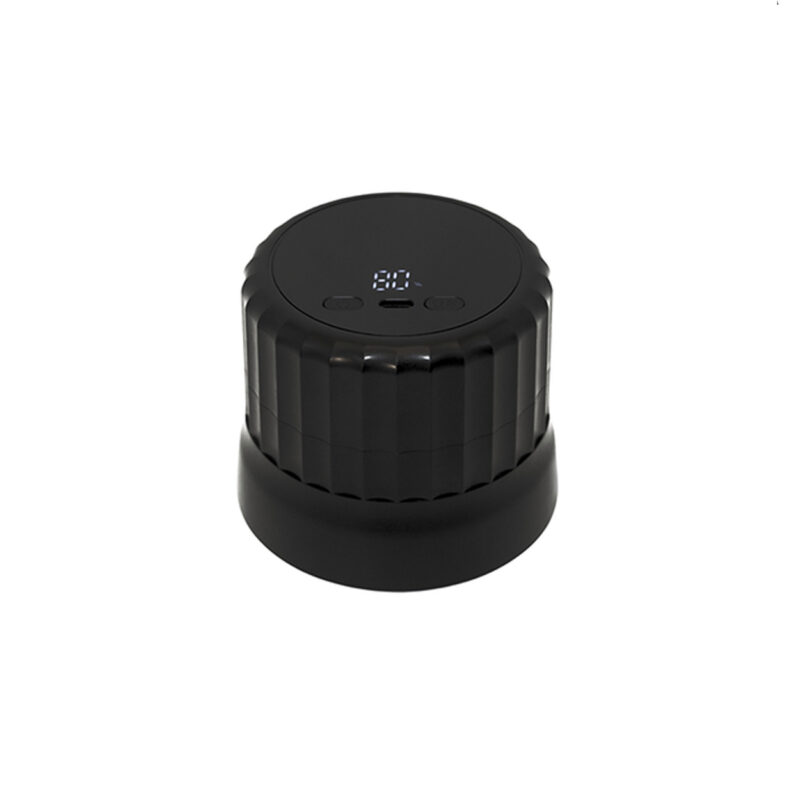
Thirty units fit in one export carton, and that single number decides whether a mason jar vacuum sealer earns its slot on your shelf or eats your freight budget. A mason jar vacuum sealer is a cordless handheld pump that pulls air out of a standard Mason jar through a lid adapter — no bag, no heat strip, no mains cable. The UAH09HX does that at 15 W and 60 kPa, about 60 seals per charge.
// 01 — Key takeaways
One 2000 mAh charge covers about 60 jar cycles. We build these on our own lines — the factory figures and the certification names we hold are set out on our Trust Center, with no documents implied that we do not issue.
Suction at the nozzle. Enough to seat a two-piece Mason lid firmly; well short of a bag machine’s chamber pull.
Motor draw on a 7.4 V pack. Small enough to run a mason jar vacuum sealer cordless, which is the whole point of the format.
Lowest catalogue tier, reached at 2,000 units. The single-tier list price is $8.00.
Export carton 55×34×31 cm at 17.2 kg gross. That ratio drives your landed cost more than the unit price does.
Warranty on every unit. Compliance marks are named in plain text on request — CE, RoHS, FCC and the battery transport paperwork that a lithium cell requires.
// 02 — Definition
What a mason jar vacuum sealer actually does
A mason jar vacuum sealer removes headspace air from a rigid glass jar through a silicone lid adapter, then lets the two-piece canning lid hold the vacuum. It does not heat-seal anything. The jar and its own lid are the package; the appliance is just the pump.
Jar sealing vs bag sealing: what changes?
A bag machine welds a plastic seam under heat, so the seal is permanent and single-use. A jar sealer leaves you with a reusable glass container that can be opened and re-pulled indefinitely. For a retailer, that difference is the sales pitch: no consumable bags, no roll refills, no ongoing spend after the first purchase.
It also caps what the product can do. Rigid jars will not conform to a chicken breast or a coffee brick, so the format lives alongside a bag sealer rather than replacing one.
Does vacuum sealing a jar replace canning?
No, and this is the line that matters most on your packaging copy. Oregon State University Extension is direct about it: vacuum packaging is not a preservation method on its own, and removing oxygen actually favours Clostridium botulinum in low-acid moist foods held at room temperature.
Dry pantry goods are the safe, honest use case. Rice, flour, coffee, nuts and dried fruit hold much longer with the oxygen pulled out, because oxidation and moisture pickup are what stale them.
Which jar mouths does it fit?
The UAH09HX ships with both wide-mouth and regular-mouth silicone adapters in the box, plus a wine stopper, a sealing plug and an external hose for canisters and bags. Sealing widths are listed at 7 cm and 8.6 cm, which are the two standard Mason jar mouth diameters.
// 03 — Duty cycle
The 2000mAh pack and the 60-seal duty cycle
The 2000 mAh, 7.4 V pack is rated for roughly 60 jar cycles per full charge, recharged over Type-C. At 3.5 L/min ±15% flow, a typical pint jar evacuates in seconds, so the pack is spent by cycle count rather than by run minutes.
How many jars per charge?
Sixty is the catalogue figure and it is a cycle count, not a runtime. A household sealing a week of pantry jars runs maybe six cycles, so the practical answer for a consumer is roughly two months between charges. That is the claim worth printing on the box, because it is the one a buyer can actually feel.
What the 3.5 L/min flow rate means
Flow rate is how fast the pump moves air; suction is how deep it eventually pulls. At 3.5 L/min a half-litre jar’s headspace clears quickly, and the motor stops when it reaches 60 kPa rather than running on. Low flow with high suction feels slow; high flow with low suction feels weak. This unit sits deliberately in the middle for a hand-held format.
Charging and shelf life in retail packaging
Lithium packs self-discharge on the shelf. Units that sit in a distribution centre for a season arrive at the customer partly flat, and a flat first impression generates returns that have nothing to do with build quality. Ask for a shipped-state charge level in your PO and print a “charge before first use” line on the quick-start card.
// 04 — Specifications
UAH09HX spec sheet, read as a buyer
Eight numbers describe this mason jar vacuum sealer. Four of them — power, suction, flow rate and battery capacity — predict how it performs on a jar. The rest describe what it is made of and what ships in the box.
UAH09HX spec sheet
Rev. 2026.09
| Spec | This model | Why it matters |
| Rated power | 15 W | Low enough to run off the internal pack all day; sets the ceiling on suction |
| Motor voltage | 7.4 V | Two-cell lithium pack, the standard configuration for this class |
| Battery capacity | 2000 mAh | Drives the ~60-cycle claim; also the figure your freight forwarder asks for |
| Suction | 60 kPa | Seats a two-piece Mason lid; not a substitute for a chamber machine |
| Flow rate | 3.5 L/min ±15% | How quickly a jar clears — the part the end user perceives as “fast” |
| Sealing width | 7 cm / 8.6 cm | Covers regular-mouth and wide-mouth Mason jars from one box |
| Material | ABS + silicone | Food-contact silicone on the adapter; ABS body keeps unit weight at 0.5 kg |
| In the box | Jar adapters, hose, lid opener, sealing lid, suction cup, sealing plug, wine sealer | Accessory count is what justifies a gift-set SKU at retail |
Figures above are catalogue values from our own product record; the approved golden sample governs the contract.
Which numbers matter most on a mason jar vacuum sealer?
Suction and flow rate, in that order. Suction decides whether the lid seats at all; flow rate decides whether the user waits. Wattage is a proxy for both and is the number most listings lead with, which is why a 15 W handheld and a 120 W countertop machine get compared as if they do the same job. They do not.
// 05 — Comparison
Cordless vs corded: where each one wins
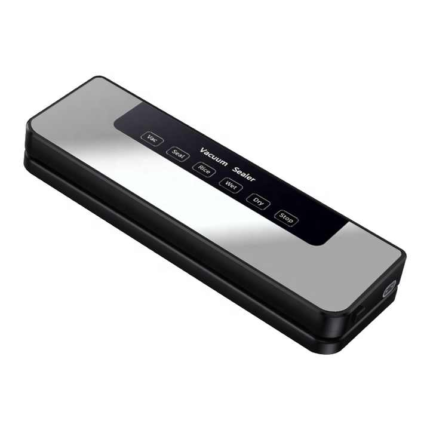
A mason jar vacuum sealer and a countertop bag sealer solve different problems. The handheld owns reusable rigid containers and portability; the countertop machine owns bulk freezer work with a heat-sealed seam. Most catalogues need one of each, not one instead of the other.
| Model | Power | Suction | Seal interface | Lowest catalogue $/unit |
|---|---|---|---|---|
| UAH09HX This model | 15 W | 60 kPa | Mason jar adapters, 7 / 8.6 cm | $6.50 at 2,000 units |
| UAH60G | 120 W | 65 kPa | 30 cm seal bar, 3 mm strip | $8.20 at 5,000 units |
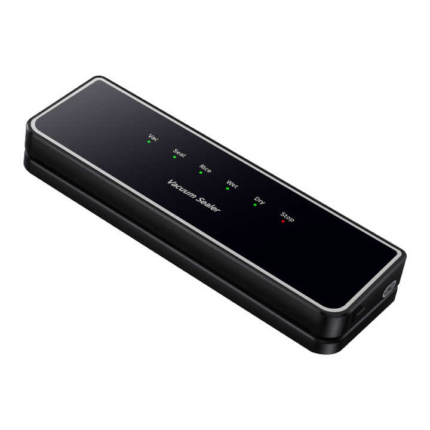
| UAH34G | 120 W | 65 kPa | 30 cm seal bar plus bag cutter | $8.30 at 5,000 units |
When the countertop model is the right call
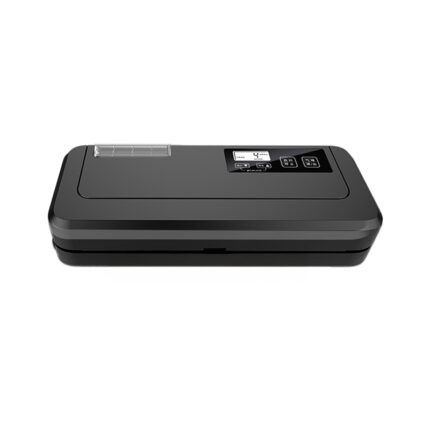
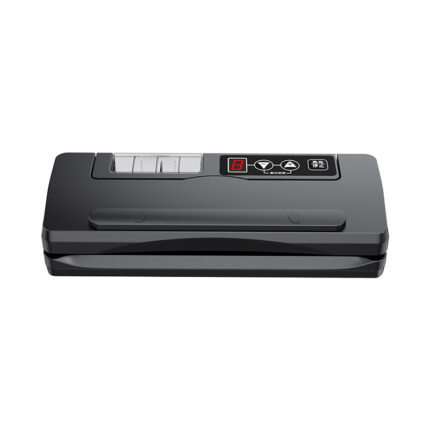
If the end user’s job is portioning meat for the freezer, they need a heat-sealed bag and a 30 cm seal bar. Our UAH60G compact sealer runs 120 W at 65 kPa with wet and dry modes, and its external hose port drives the same jar adapters. It costs more per unit and needs mains power and 36.5 cm of counter.
Where the handheld wins on shelf space
The UAH09HX packs at 10.7×10.7×14.5 cm and weighs 0.5 kg. Thirty fit in a carton against 20 for the countertop models, and the retail box stands on an endcap rather than needing a shelf run. For gift, camping and small-kitchen ranges, that footprint is the product.
Buyers ask us for suction first and freight last. It is nearly always the other way round: 60 kPa or 65 kPa will not change a single customer review, but 30 units per carton against 20 changes your landed cost on every container you ever ship.
— Mi Lan, Founder, Guilin Prime Household Products Co., Ltd.
// 06 — Safety
Food-safety limits you must put on the box
Vacuum packaging slows oxidation; it does not make food shelf-stable. Any product that removes oxygen from a food container needs plain instructions saying refrigeration and freezing still apply, because the anaerobic environment is the exact condition botulism spores prefer.
Why vacuum is not preservation
The USDA’s Food Safety and Inspection Service draws the boundary clearly in its shelf-stable food guidance: shelf stability comes from heat processing, acidity, drying or a controlled water activity — not from removing air. Anything that needed the fridge before sealing still needs it after.
Utah State University Extension makes the same point about home food packaging, and adds the useful practical framing: dry goods gain the most, wet and low-acid foods gain the least and carry the most risk.
What to print on the retail box
Three lines cover it. First, dry goods only for pantry storage. Second, refrigerate or freeze anything perishable exactly as before. Third, a mason jar vacuum sealer is not a canner and does not process food. Distributors in the EU and North America increasingly ask for that wording up front, and it costs nothing to add at artwork stage.
// 07 — Manufacturing
How we manufacture this mason jar vacuum sealer
Guilin Prime Household Products has manufactured and traded household appliances since 2005, and this model is one we build rather than buy in. Four stages sit between a tooling drawing and a sealed carton, and each one has a pass or fail that a unit has to clear before it moves on.
In-house tooling and molding
The ABS housing and the silicone jar adapters run from our own moulds. Owning the tool is what lets a private-label buyer change colour, parting lines and logo position without paying for a new cavity.
Pump and PCBA burn-in
Pump assemblies and control boards are powered up and cycled before they meet a housing, so a dead motor or a mis-flashed board is caught at component stage rather than at final assembly.
Vacuum and battery quality control
Units are drawn against a jar and held to see that the lid stays seated, and packs are checked for charge acceptance. Cells for export orders carry the transport test documentation a lithium shipment requires.
Compliance and warranty
We build to CE, RoHS and FCC and issue the certificates and test reports relevant to your order and destination market — names in plain text, documents on request. Every unit carries a 12-month warranty.
// 08 — Trade terms
Wholesale terms, tiers and battery freight
Pricing on this model runs from $8.00 at the entry tier down to $6.50 at 2,000 units. Lead time is 15–30 days for bulk production after deposit, samples in 3–7 days, on 30/70 T/T with Alibaba Trade Assurance supported.
What does the mason jar vacuum sealer cost at volume?
| Tier quantity | Unit price | Discount vs list |
|---|---|---|
| 10 | $8.00 | — |
| 200 | $6.85 | $1.15 |
| 500 | $6.75 | $1.25 |
| 2,000 | $6.50 | $1.50 |
The curve flattens fast. Almost the whole discount arrives by 200 units, which means a distributor testing the model does not have to commit container volume to reach a workable margin. MOQ is typically 100 units per model. The 10-unit row above is a sample/trial tier, available on request rather than a standard production order.
Lithium battery documentation
A 2000 mAh pack makes this a lithium shipment, and carriers will ask for the battery transport test paperwork and a correctly marked carton before it flies. Build that into your schedule: it is routine for us and it is the single most common reason a first-time buyer’s air shipment sits an extra day at origin.
Carton, cube and chargeable weight
One carton holds 30 units in 55×34×31 cm at 17.2 kg gross. Because the carton weighs more than its volumetric equivalent, air freight prices it on actual weight — unusual for a small appliance, and it works in your favour. Sea freight buyers should plan on 0.058 m³ per carton.
// 09 — Fit
Who should stock this model
A mason jar vacuum sealer is a volume accessory, not a hero appliance. It works for buyers who need a low-ticket, high-turn item with a clear demo: pull a jar, watch the lid suck down, done. It is a weak fit for anyone selling on freezer-portioning capability.
Distributors and retail chains
At $6.50 to $6.85 per unit ex-works, before freight and duty, the model supports a $19 to $29 retail band in most markets on a single global SKU, since the unit charges over Type-C from any standard USB source rather than a mains transformer. That removes the per-market plug variants that usually fragment a small-appliance order.
Private-label and gift-set programs
The accessory bundle is the lever here. Jar adapters, hose, wine stopper and sealing plug already justify a boxed gift SKU, and our own moulds mean colour, logo and packaging change without new tooling cost. Tell us the market and the volume and we will quote the OEM variant against this same platform.
// 10 — Questions
Mason jar vacuum sealer FAQ
The six questions below are the ones buyers and end users ask most often about this format, answered against this model’s real specification rather than category generalities.
How long does food last in a vacuum-sealed Mason jar?
Does a mason jar vacuum sealer replace home canning?
How many jars can it seal on one charge?
Which Mason jar sizes and mouths does it fit?
What is the MOQ, lead time and warranty?
How does the lithium battery affect shipping?
// 11 — Conclusion
Conclusion
Buy this model for what it is: a $6.50-to-$8.00 cordless accessory that turns any Mason jar into a resealable vacuum container, sixty times per charge, thirty to a carton. Buy a 120 W countertop sealer separately if your customer’s real job is freezer bags.
The mason jar vacuum sealer decision does not turn on suction. It turns on whether your range needs a low-ticket, high-turn item with a two-second demo and no consumables attached — and on whether your logistics team is set up for lithium cells. Both of those are answerable before you request a single sample.
UAH09HX — cordless mason jar vacuum sealer
Model UAH09HX
Mason Jar Vacuum Sealer, 15W, 2000mAh, Cordless
15 W · 60 kPa · 3.5 L/min · 2000 mAh · 7 / 8.6 cm jar adapters · ABS and silicone
from $6.50 / unit
Similar products

Vacuum Sealer, 120W, 65kPa, 30cm Seal, Bag Cutter
Seladora a Vácuo, 220W, Selagem de 29cm, Touch, Bocal Automático
Zgrzewarka próżniowa, 180W, zgrzew 28cm, wydłużona dysza
Vakuumiergerät, 120W, 65kPa, Kompakt, Touchscreen
Ready to order or need a wholesale quote?
Prime Household manufactures and trades these appliances direct from Guilin, China — OEM, private-label and B2B welcome. Tell us your market and volume.


